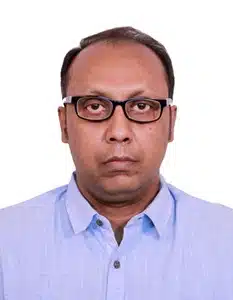
Dr. Ambarish Dutta

Dr. Ambarish Dutta​

Professor

Dr. Ambarish Dutta

A Brief Biography:

I am a public health anthropologist working in the intersection between climate change, public health and health system. My doctoral research was on social determinant of child health in the Indian Sundarbans- a globally known climate change hotspot as a part of health systems research to improve access, affordable and quality health services for the marginalized. During my PhD, climate change impacts emerged as the most crucial determinants to children’s health in the Sundarbans by mediating all other determinants like parents’ livelihood, shelter, nutrition, education and so on. Post PhD, my work focuses on impacts of climate change on community health and health care delivery system. I aimed to understand social vulnerabilities of the communities experiencing climate change and also throws light on the Planetary health dynamics impacting transformational changes towards climate resilient health system. Currently, I am building up community based practical knowledge towards a sustainable pathway of change in health policy process for the vulnerable and disadvantageous populations. My work also focuses on building climate resilient and low carbon health system in Indian context and climate adaptation-mitigation co-benefit.

Academic Qualifications

MBBS, MPH, PhD

Research Areas

Malaria, TB, Evaluation of health programmes, NCD, ageing

List of Your Publications:

References

  1. Jain HK, Das A, Dixit S, Kaur H, Pati S, Ranjit M, Dutta A, et al. Development and implementation of a strategy for early diagnosis and management of scrub typhus: an emerging public health threat. Front public Heal [Internet]. 2024;12:1347183. Available from: http://www.ncbi.nlm.nih.gov/pubmed/38660358
  2. Ghosal J, Bal M, Das A, Panda B, Ranjit M, Behera MR, Kar S, Satpathy SK, Dutta A, Pati S. To leave no one behind: Assessing utilization of maternal newborn and child health services by all the 13 particularly vulnerable tribal groups (PVTGs) of Odisha, India. Heal Res Policy Syst [Internet]. 2024 Jan 22;22(1):12. Available from: https://health-policy-systems.biomedcentral.com/articles/10.1186/s12961-023-01101-7
  3. Ghosal J, Dutta A, Kshatri JS, Das A, Kanungo S, Singh A, et al. Development, validation & pilot testing of a questionnaire to assess healthcare seeking behaviour, healthcare service utilization & out-of-pocket expenditure of Particularly Vulnerable Tribal Groups of Odisha, India. Indian J Med Res [Internet]. 2023 May;157(5):412–20. Available from: https://journals.lww.com/10.4103/ijmr.ijmr_3570_21
  4. Mohanty P, Patnaik L, Srivastava S, Muhammad T, Dutta A. Dietary Patterns and Lifestyle Changes during COVID-19 Lockdown: A Cross-Sectional Online Survey among 674 Indian Older Adults. Ageing Int [Internet]. 2023 Dec 23; Available from: https://link.springer.com/10.1007/s12126-023-09539-4
  5. Gandhi N, Qadeer AS, Meher A, Rachel J, Patra A, John J, …. Dutta A, et al. Costs and models used in the economic analysis of Total Knee Replacement (TKR): A systematic review. Li M, editor. PLoS One [Internet]. 2023 Jul 25;18(7):e0280371. Available from: http://dx.doi.org/10.1371/journal.pone.0280371
  6. Nayak, G., Ghosal, S., Ghosal, J., & Dutta, A. (2023). What causes concordance of hypertension between spouses in India ? Identifying a critical knowledge gap from a nationally representative cross sectional sample of 63 , 020 couples aged. BMC Public Health, 1–10. https://doi.org/10.1186/s12889-023-16379-z
  7. Ghosal, J., Bal, M., Ranjit, M., Das, A., & Behera, M. R., Dutta, A., Pati, S. (2023). To what extent classic socio economic determinants explain trends of anaemia in tribal and non tribal women of reproductive age in India ? Findings from four National Family Heath Surveys ( 1998 – 2021 ). BMC Public Health, 1–12. https://doi.org/10.1186/s12889-023-15838-x
  8. Mohapatra, M. K., Pradhan, A., Tiwari, D., Yunus, S., Patro, B. K., Behera, B. K., Sahu, S., Bhatia, V., Bhattacharya, S., Paithankar, P., & Dutta, A. (2023). Effectiveness of Fortified Mid-Day Meal in Reducing Anemia Among School Children in Dhenkanal, Odisha: A Quasi-Experimental Study. Food and Nutrition Bulletin, 3795721231172253. https://doi.org/10.1177/03795721231172253
  9. Bal, M., Ghosal, J., Das, A., Sandeepta, S., Pati, S., Dutta, A., & Ranjit, M. (2023). Impact of Sub-patent Malaria During Pregnancy on Birth-Weight in Odisha, India: Time-to-Event Analysis of Prospective Longitudinal Follow-Up of a Survey. Journal of Epidemiology and Global Health, 0123456789. https://doi.org/10.1007/s44197-022-00082-0
  10. Nanda, L., Chakraborty, S., Mishra, S. K., Dutta, A., & Rathi, S. K. (2022). Characteristics of Households’ Vulnerability to Extreme Heat: An Analytical Cross-Sectional Study from India. International Journal of Environmental Research and Public Health, 19(22), 15334. https://doi.org/10.3390/ijerph192215334
  11. Mohanty, P., Patnaik, L., Nayak, G., & Dutta, A. (2022). Gender difference in prevalence of hypertension among Indians across various age-groups: a report from multiple nationally representative samples. BMC Public Health, 22(1), 1524. doi: 10.1186/s12889-022-13949-5
  12. Nanda, L., Lobo, E., Menon, G. R., Dhopte, Paratik., Akhouri, Shuchi Sree., Shrivastava, Chandni., Ronghang, Roshan., Anilkumar, Aiswarya., Dutta, A. (2022). Disability Weights Estimates From India in 2018: Measurements From Community Members From Two Distinct States of India. Frontiers in Public Health, 10(March), 1–9. https://doi.org/10.3389/fpubh.2022.752311
  13. Pradhan, M. M., Pradhan, S., Dutta, A., Shah, Naman K., Valecha, Neena., Joshi, Pyare L., Pradhan, Khageshwar., Grewal Daumerie, Penny., Banerji, Jaya., Duparc, Stephan., Mendis, Kamini., Sharma, Surya K., Murugasampillay, Shiva., Anvikar, A. R. (2022). Impact of the malaria comprehensive case management programme in Odisha, India. Plos One, 17(3), e0265352. doi:10.1371/journal.pone.0265352
  14. Bal, M., Rana, R., Das, A., Khuntia, Hemant Kumar., Somalkar, Nilam., Sahoo, Niranjan., Ghosal, Jyoti., Pati, Sanghamitra., Dutta, A., Ranjit, M. (2021). Neglected malaria parasites in hard-to-reach areas of Odisha, India: implications in elimination programme. Malaria Journal, 20(1), 482.
  15. Govindasamy, K., John, A. S., Lal, V., Arif, Mohammad., Solomon, Raju Moturu., Ghosal, Jyoti., Dutta, A. (2021). A comparison of three types of targeted, community-based methods aimed at promoting early detection of new leprosy cases in rural parts of three endemic states in India. PLOS ONE, 16(12), e0261219.
  16. Dutta, A., & Nayak, G. (2021). Concerns about the prevalence estimates of undiagnosed hypertension among women aged 15-49 years in India. Journal of Human Hypertension. doi:10.1038/s41371-021-00626-0
  17. John, A. S., Karthikeyan, G., Dutta, A., Lal, V., Arif, M. A., & Raju, M. S. (2021). Leprosy Awareness , Knowledge and Attitude in the Community Across Three Endemic States in India : A Cross-sectional Study. Indian Journal of Leprosy, 93(001), 271–280.

Join PHFI IPHS

(Deemed to be University)

Become part of a vibrant academic community shaping the future of global health

Call Now Apply Now

Admission Inquiry